
If a business has a back door or stairwell exit that staff should not use casually, there is a good chance it carries an exit alarm: a boxy unit on the door, usually with a sign warning that an alarm will sound. Anyone can still get out in an emergency without a key, and when the door opens, a loud horn lets everyone know. Detex, a Texas company that makes exit alarms and exit hardware, is the name on many of these units.
The two setups you are likely to have
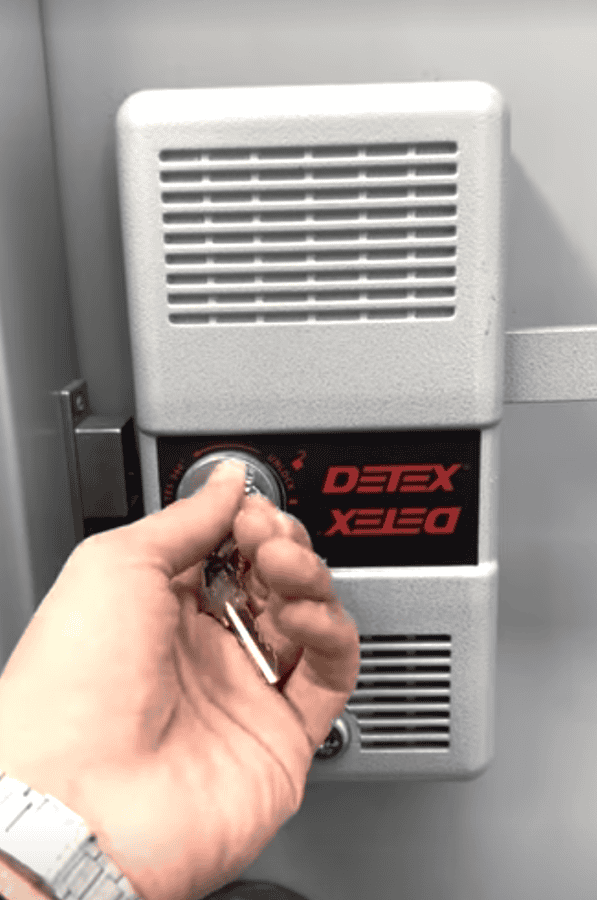
A stand-alone exit alarm. Models such as the Detex EAX-500 mount on a door that already has its own exit hardware. A magnet on the frame keeps the alarm quiet while the door is shut; open the door and the horn sounds. The alarm runs on a battery, and a key switch on the unit arms it, turns it off and resets it.
An alarmed exit lock or panic bar. Here the lock and the alarm are one device, such as the Detex ECL-230D exit control lock. Pushing the bar releases the door and sets off the alarm at the same time. The key resets the alarm afterward and, on most units, lets staff open the door without setting it off.
Common problems and what they usually mean
- It chirps every so often. On battery units this is usually the low-battery warning. Replace the battery with the type printed on the unit and reset it with the key. If a fresh battery does not stop it, the unit needs a closer look.
- It will not arm, or goes off as soon as it is armed. The door is probably not fully closed, or the magnet no longer lines up with the alarm. A sagging door or a closer that no longer pulls the door shut is the usual cause, which is why exit alarm trouble often turns out to be a door and closer problem.
- It stays silent when the door opens. A dead battery, a loose wire on a hard-wired unit, or a failed alarm. Test it on a regular schedule so you find this before it matters.
- The bar is hard to push, or the door sticks. The bolt is often binding on the strike because the door has shifted. On an emergency exit, get this fixed right away.
- Nobody can find the key. The key switch uses a standard lock cylinder that can be rekeyed or replaced, so the alarm key can match what managers already carry.
Keep the exit an exit
An alarm is fine on an emergency exit; anything that stops people from getting out is not. A required exit has to open from the inside without a key or special knowledge, so chains, padlocks and deadbolts that need a key from the inside do not belong on it. Delayed-egress locks, which hold the door for a set time before releasing, are allowed only under specific conditions, so check with building management or a code consultant first. If the exit also has to lock from the outside, that calls for exit hardware with outside trim, not an extra lock.
What installation involves
It starts with the door: whether it already has a panic bar, what it is made of, and whether it faces the weather. Then the alarm and magnet, or an alarmed exit device, go on, the keys are set up, and staff see how it works. In June 2026 we installed a door closer and a Detex exit alarm on an emergency exit in TriBeCa; that job is on Our Work. For the hardware itself, see panic bar installation and exit device repair.
We are based at our storefront at 130 7th Ave S in Greenwich Village and take service calls across all five boroughs, plus nearby Nassau County and Westchester. For an exit alarm that chirps, will not arm, or has not been installed yet, call (917) 495-1990 or text us a photo of the unit.